
Reading labels: understanding quantities and NRVs
NRV stands for nutrient reference value. The percentage compares the stated amount of a vitamin or mineral with a reference value set by law for adults.
View products
Editorial team: Ortho-Vertrieb.de · Content reviewed on .
Check the details of the specific offer
These products illustrate different forms. See each product for its ingredients, pack contents and instructions. The fictional calculations in this article do not refer to any of these offers.
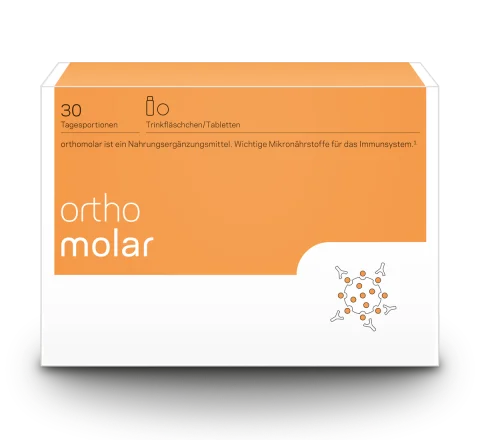
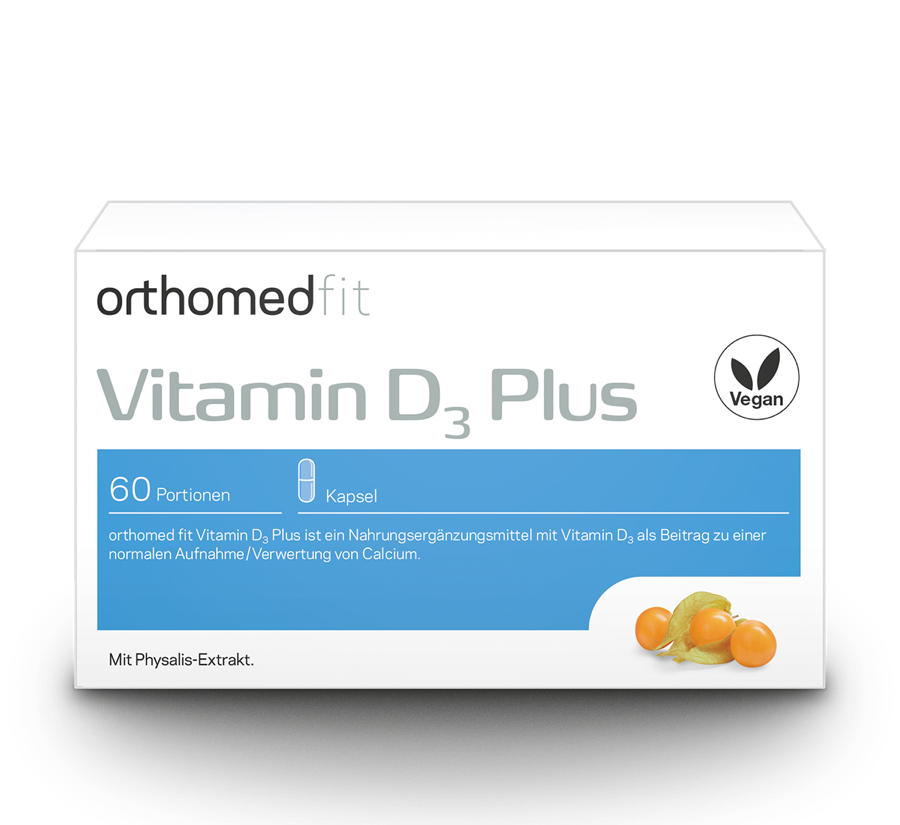
Orthomedfit Vitamin D3 Plus
Capsules
Available
€15,99
Unit price: 1.402,63 € / kg
including VAT, plus Shipping costs
The images show the product range. Refer to the full variant name and the information for the selected form.
What does the stated quantity refer to?
Food supplement labels give the amounts of the characteristic nutrients or other substances per recommended daily portion. For vitamins and minerals, a percentage is also given where a reference value has been set. This information describes Section 4(3) of the German Food Supplements Regulation.
Start with the heading of the quantities table. “Per daily portion” has a different basis from “per tablet” or “per 100 g”. Compare figures only when both the units and the basis match. Milligrams and micrograms also differ: 1 mg equals 1,000 µg.
Worked example of an NRV percentage
The statutory nutrient reference value for vitamin C for adults is 80 mg. It is listed in Annex XIII, Part A of the Food Information Regulation .
Fictional calculation: Suppose a fictional daily portion contains 40 mg of vitamin C. Its percentage of the NRV would be 40 mg ÷ 80 mg × 100 = 50%. The 40 mg is an invented figure. It describes neither a product on sale nor a recommended intake. Use the same unit for the amount and the reference value.
The NRV is neither a personal requirement nor an individual intake recommendation or a safe upper limit. Even a value of 100% or more does not establish whether a product suits a particular person. A higher percentage is no reason to increase your intake.
The ingredients list and quantities table answer different questions
The ingredients list names the ingredients used to make a product. The quantities table states the amounts of selected nutrients or other characteristic substances. An ingredient name therefore does not necessarily correspond to a figure in the table. Check both for the specific version you are comparing.
Not every substance has a legally defined NRV. If no percentage is shown, the substance is not necessarily absent and its amount is not necessarily zero. Read the stated amount and any footnote. No NRV percentage can be calculated from this table for a substance without a set reference value.
How to read the label step by step
- Check the full product name and form.
- Read the recommended daily intake and check its components.
- Read amounts, units and any NRV percentages together.
- Also check the ingredients list, storage instructions and warnings.
Reading the label is no substitute for individual advice. The name of the form alone tells you nothing about the amounts declared. For more examples of the relationship between item count and portions, see Pack sizes and daily portions. For preparation, see Product forms.